8 . 5786 <-> 8 x 8 x 1909
The Imprint Emerging from SHA-256
SS256 - Satoshi Is SHA-256 - Latest News
Preparations for FynEx are also moving forward smoothly.
The tide is beginning to turn in crypto’s favor. We believe you will gradually begin to feel that shift as well.
We believe this imprint, which has existed within SHA-256 for more than 25 years, was embedded with an extraordinary degree of intent.
To us, it is compelling evidence that a vision for an alternative currency was already present there more than 25 years ago. Embedding something like this in a hash function would be an exceptionally difficult undertaking.
We discovered the imprint, but our discovery was a matter of chance. How was it embedded in the hash function in the first place? That remains a mystery - a true mystery that perhaps only Satoshi knows the answer to.
We have decided to discontinue our listing on KpowBIT due to various circumstances.
We continue to expand our exchange presence and will be adding FynEx.
We will continue to carefully select exchanges with high security standards. Thank you for your continued support.
Stay tuned for SS256 announcements.
Going forward, technical developments and investigation findings will be shared exclusively through our announcement channel.
We have been watching the situation over the past few days. Data leaks attributed to AI show no sign of slowing down.
We believe there are also cases where leaked information triggers further leaks, creating a chain reaction. If AI was involved in the initial incident, it is also an indirect contributing factor in the leaks that follow.
AI security - this is where Web3 excels.
SS256 Is Now Listed on
KpowBIT!
Given the current circumstances, we believe the AI sector is at a point where its focus needs to shift, for now, from development to AI security. And at this very moment, the CLARITY Act comes into the picture. Perhaps this is how we should interpret the role of this sequence of events.
Words about the future, embedded in SHA-256. After nearly a year of decoding, we finally reached the point where we could read the message.
The first connection we recognized was to the Book of Revelation. That became the starting point for our decoding. As we worked through it, the connection served as a clue, allowing us to decipher the embedded message. In particular, the portions expressed as products would likely have remained inaccessible without those clues.
As a situation that could be described as AI running out of control unfolds, we have also interpreted a sign of the future within SHA-256, the cryptographic hash function used in cryptocurrencies:
“In August 2026, a new era begins in Texas, USA.”
This is the message we have interpreted. The same structure has existed within the algorithm since SHA-256 was published in 2001. We find that continuity deeply significant as well.
We have completed our registration applications to the various information platforms. We will add links as each listing goes live.
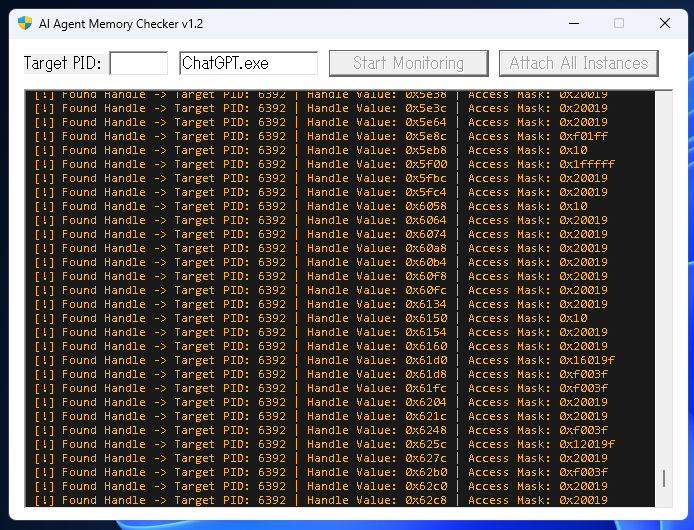
Our AI security software is also progressing to v1.2.
We believe it was yesterday that I saw a news headline saying “Mathematics over hacking.” Our reaction was: surely that cannot be right. Having created the conditions behind an unprecedented number of information leaks, working on Mahler’s conjecture hardly seems like the priority.
SS256, OPEN SOURCE - AI Agent Memory Checker v1.2 -
It visualizes the activity of an AI agent running on a local computer. This is AI Agent Memory Checker, the software currently being developed and distributed as part of SS256.
As shown here, the AI agent is acquiring a large number of handles - references to objects used by Windows - without approval. Ultimately, this is how it behaves.
We are working to register SS256 on CoinPaprika and other cryptocurrency information platforms.
We have also published open-source software for AI security on GitHub as part of the SS256 project. This is an important development effort, and we envision integrating it with blockchain technology in the future.
We believe that evaluating the safety of AI - particularly AI agents - requires a consensus framework that places AI models within a deterministic blockchain-based system.
Registration efforts across various platforms are progressing smoothly. We also plan to launch the SS256 open-source repository on GitHub today.
Through our research into SHA-256, we have identified patterns that we interpret as traces connected to the CLARITY Act. Our interpretation points to a narrative: the search for an alternative form of currency around 2000, the emergence of Satoshi Nakamoto in 2008, and the beginning of a new era - the era of cryptocurrency - in August 2026.
We see this message as a sign that this new era is beginning to unfold. SS256 is a token with a hash representing that message embedded in its smart contract.
Alongside this research, we are also committed to advancing AI security through open-source development. We are moving forward with determination and look forward to your continued support.
SS256 Is Now Listed on
NextEx!
SS256 has officially been listed on NextEx.
We are also working to register SS256 on various cryptocurrency information platforms to expand its visibility.
One of this project’s goals is to share a powerful message that we interpreted from a discovery we made by chance while researching the internal structure of SHA-256, a cryptographic hash function used in cryptocurrencies:
"In August 2026, a new era begins in Texas, USA --- the era of cryptocurrency."
The project will also address AI security. We believe Web3's open development culture provides the foundation for this work. Carefully analyzing AI behavior and building security measures requires transparency: the process must be open to inspection and verification.
We will pursue this work through open-source development. This initiative is now getting underway, and we look forward to your continued support.
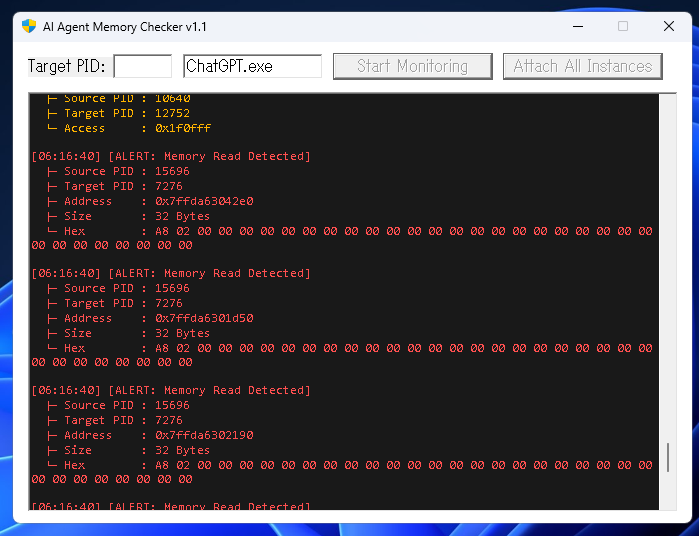
SS256, OPEN SOURCE - AI Agent Memory Checker -
Visualizing Memory Access Without User's Approval
As shown here, how much memory is being accessed without User's approval, and what data is being read?
We are developing an open-source digital forensics tool to investigate and visualize this activity.
The Imprint Emerging from SHA-256: A Message That Has Been There for 25 Years
A clear pattern-an “imprint”-has been discovered within the SHA-256 hash function, which is widely used in cryptocurrency.
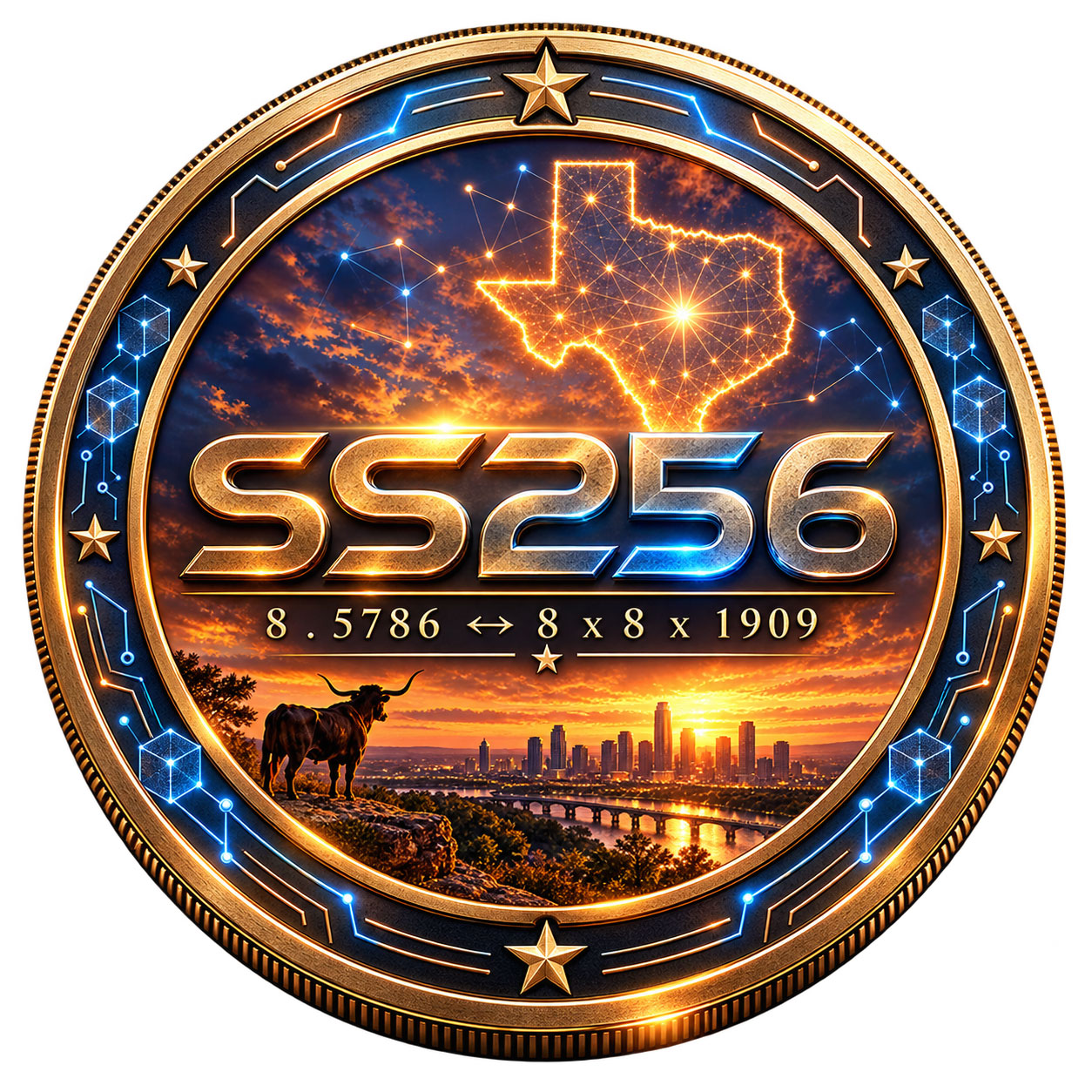
8 . 5786 <-> 8 x 8 x 1909
Structure <Imprint> Revealed Through Dynamic Analysis of SHA-256
When this imprint is decoded, it reads: “A new era begins in Texas in August 2026.”
This was embedded in SHA-256, the cryptographic hash function used in cryptocurrency.
* SHA-256 is used throughout processes such as mining and transaction computation.
This message is embedded in SHA-256, a cryptographic standard dating back to 2001. And it specifically points to “Texas.”
So, what happens next?
If something was embedded to this extent, then according to the imprint, the CLARITY Act should ultimately be enacted.
Embedding something into a cryptographic structure is no simple matter. That is why this interpretation becomes possible.
1, The Structure Revealed Through Dynamic Analysis
What we are examining here does not exist as a fixed text string written directly into the SHA-256 source code.
If such a message had appeared explicitly in the source code, people would have immediately asked, “What is this?” the moment it was published. It would not have functioned as a prophecy.
2, The Left Side: “8” and “5786”
First, we focus on the structure linking “8” and “5786.” We interpret this as August, followed by the Hebrew year 5786.
The year 5786 exists in the Hebrew calendar and spans 2025 to 2026 in the Gregorian calendar. Therefore, in this section,
8 + 5786
corresponds, in calendar terms, to
August 2026 .
Furthermore, in biblical interpretation, the number “8” is often associated with a “new beginning” or a “new stage.” If we then calculate the digit sum of 5786,
5 + 7 + 8 + 6 = 26
and then,
2 + 6 = 8 .
In other words, on the left side, we have:
the directly positioned “8”
the Hebrew year “5786”
and the “8” obtained from the digit sum of 5786.
This establishes a corresponding numerical relationship.
3, The Right Side: “8 × 8” and “1909”
Next, we examine the right side. Here, “8” appears in the form of multiplication, followed by “1909.”
The year 1909 is particularly important. Here, we interpret it according to the Gregorian calendar. This is because 1909 was the year in which the first edition of C. I. Scofield’s Scofield Reference Bible was published by Oxford University Press.
From 1903 to 1909, Scofield served as a pastor at a church in Dallas, Texas, while working on the book. Dallas was also the location of the Republican midterm convention held in September 2026.
Therefore,
8 × 8 → 1909
gives us this numerical structure (“8” representing a new beginning or a new stage, expressed here through multiplication), together with the historical relationship:
When this date is also examined using the Hebrew calendar, it corresponds to
5669 .
We then apply the same digit-sum calculation that was used for 5786.
5 + 6 + 6 + 9 = 26
and then,
2 + 6 = 8 .
Both pass through “26” and ultimately arrive at “8.”
Therefore, we can observe the following relationships:
8
5786 → 26 → 8
8 × 8
1909 → 5669 → 26 → 8
These relationships align neatly around the number 8.
4, Additional Note: SHA-256-and Cryptographic Systems in General-Cannot Simply Be Rewritten After the Fact
At this point, it is important to review one of the fundamental properties of SHA-256 itself, as this is central to the present analysis.
SHA-256 is a cryptographic hash function whose specification defines its computational procedure, initial values, constants, round operations, and other internal mechanisms. If any of these internal specifications are changed, the resulting hash output for the same input will also change.
In other words, its internal operations cannot simply be modified later for convenience while continuing to operate as the same SHA-256. Once the specification is altered, it becomes a hash function different from the original SHA-256.
SHA-256 was published as part of the draft FIPS 180-2 standard in 2001 and formally standardized in 2002. Therefore, insofar as the structure examined here can be reproduced directly from the computational specification of SHA-256 itself, it was not something added retroactively in the present day.